Big Picture of Debiased Machine Learning
Debiased machine learning (DML) is a generic recipe. The idea behind it is adding a correction term to the plug-in estimator of the functional, which leads to properties such as semi-parametric efficiency, double robustness, and Neyman orthogonality.
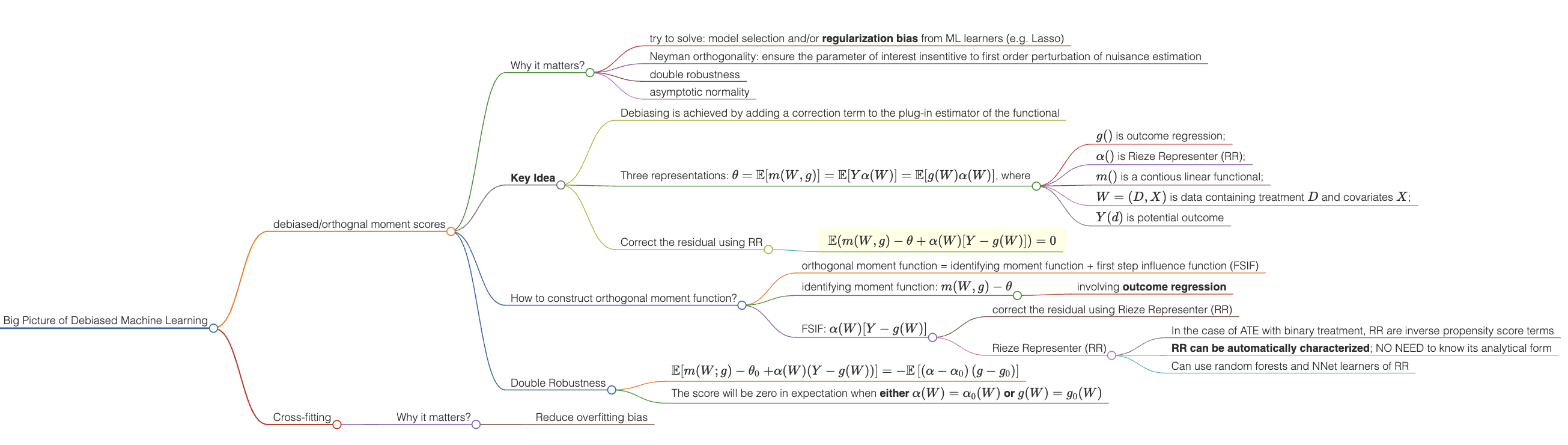
(Auto)-DML is a Method-of-Moments estimator
-
debiased/orthognal moment scores
-
Why it matters?
- try to solve: model selection and/or regularization bias from ML learners (e.g. Lasso)
- Neyman orthogonality: ensure the parameter of interest insentitive to first order perturbation of nuisance estimation
- double robustness
- asymptotic normality
-
Key Idea: Debiasing is achieved by adding a correction term to the plug-in estimator of the functional
-
Three representations: $\theta = \mathbb{E}[m(W,g)] = \mathbb{E}[Y\alpha(W)] = \mathbb{E}[g(W)\alpha(W)]$, where
- $g()$ is outcome regression;
- $\alpha()$ is Rieze Representer (RR);
- $m()$ is a contious linear functional;
- $W = (D, X)$ is data containing treatment $D$ and covariates $X$;
- $Y(d)$ is potential outcome
-
Correct the residual using RR
- $\mathbb{E}\{m(W,g) - \theta + \alpha(W)[Y-g(W)]\} = 0$
-
-
How to construct orthogonal moment function?
-
orthogonal moment function = identifying moment function + first step influence function (FSIF)
-
identifying moment function: $m(W,g) - \theta$
- involving outcome regression
-
FSIF: $\alpha(W)[Y-g(W)]$
- correct the residual using Rieze Representer (RR)
- Rieze Representer (RR)
- In the case of ATE with binary treatment, RR are inverse propensity score terms
- RR can be automatically characterized; NO NEED to know its analytical form
- Can use random forests and NNet learners of RR
-
-
Double Robustness
-
$\mathbb{E}[m(W ; g) -\theta_0 \left.+\alpha(W)(Y-g(W))\right] =-\mathbb{E}\left[\left(\alpha-\alpha_0\right)\left(g-g_0\right)\right]$
-
The score will be zero in expectation when either $\alpha(W) = \alpha_0(W)$ or $g(W) = g_0(W)$
-
-
-
Cross-fitting
- Why it matters?
- Reduce overfitting bias
- Why it matters?